CONTEXT
Productivity tool for self-publishing
ROLE
UX Lead
KEYWORDS
Complexity, workflows, prototyping
STATUS
Iterations in progress
Frontlist is a personal assistant for indie authors that guides them through the entire self-publishing process. It reflects how I approach designing for complex, fragmented systems:
→ Uncovering the structure of a problem;
→ Creating a layer for user consumption;
→ Designing for iteration first, to unlock scale later.
Unique opportunity to see my process, via a work in progress
HOW IT'S GOING
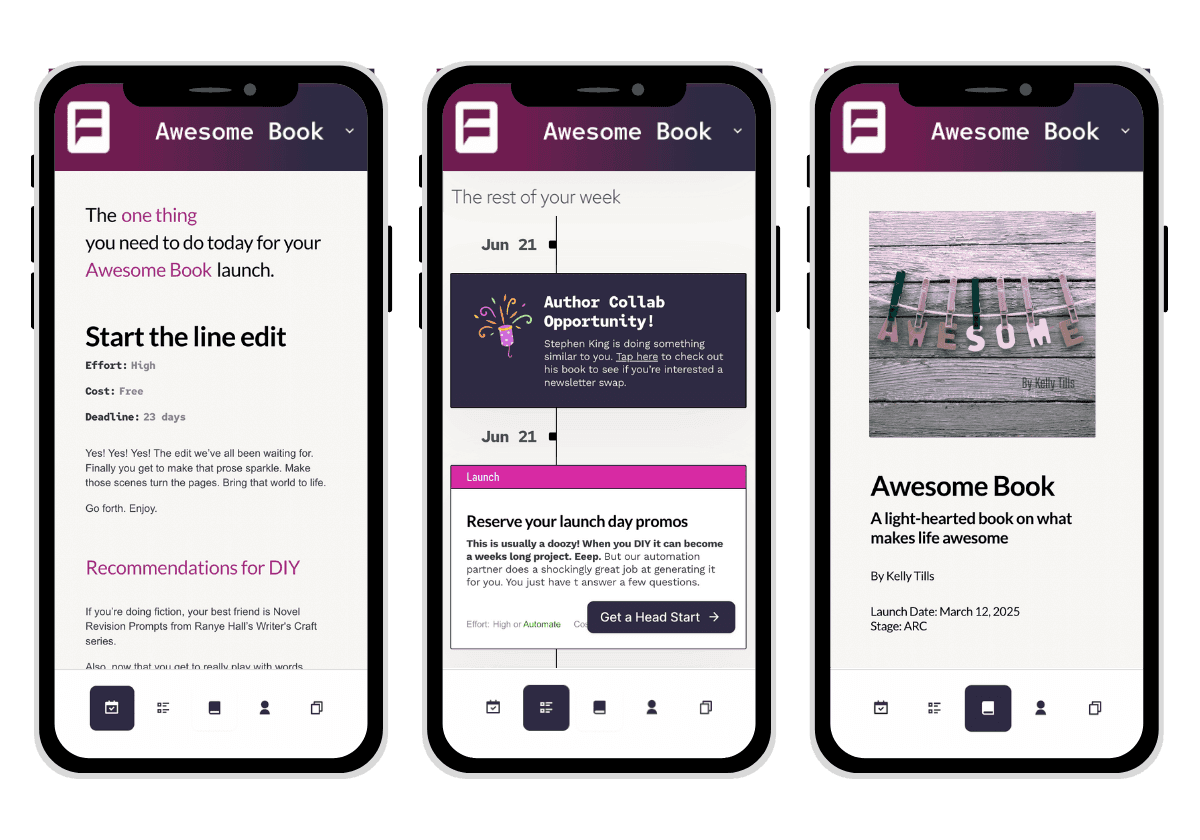

A gnarly, Fragmented problem
To get a book from “I have an idea” to “it’s published!” an indie author has to complete 60-80 milestones spanning multiple vendors, and wade through conflicting information spread willy-nilly across the internet.
Without a clear, end-to-end workflow, indie authors routinely overspend on coaching programs, vanity or hybrid publishers, and marketing courses—often while missing critical steps like lining up reviews and promotions before launch.
NO HOLISTIC SOLUTIONS — Even newer AI solutions are task-specific. They may make parts of the process more efficient, but ultimately they're just adding pieces to the puzzle, instead of holistically reducing complexity.
Why I Couldn't Ignore the Issue
I'm an indie author! But this isn't just a me problem, 2.3 million books are self-published every year.
Because I've self-published eight titles—First Designer In, Kelly Tills kids books—newer authors would frequently ask me for advice.
I found myself repeating the same complicated, caveat-filled publishing advice on call after call. None of it could be explained cleanly. There's nothing I love more than bringing order to chaos, so I got to work.
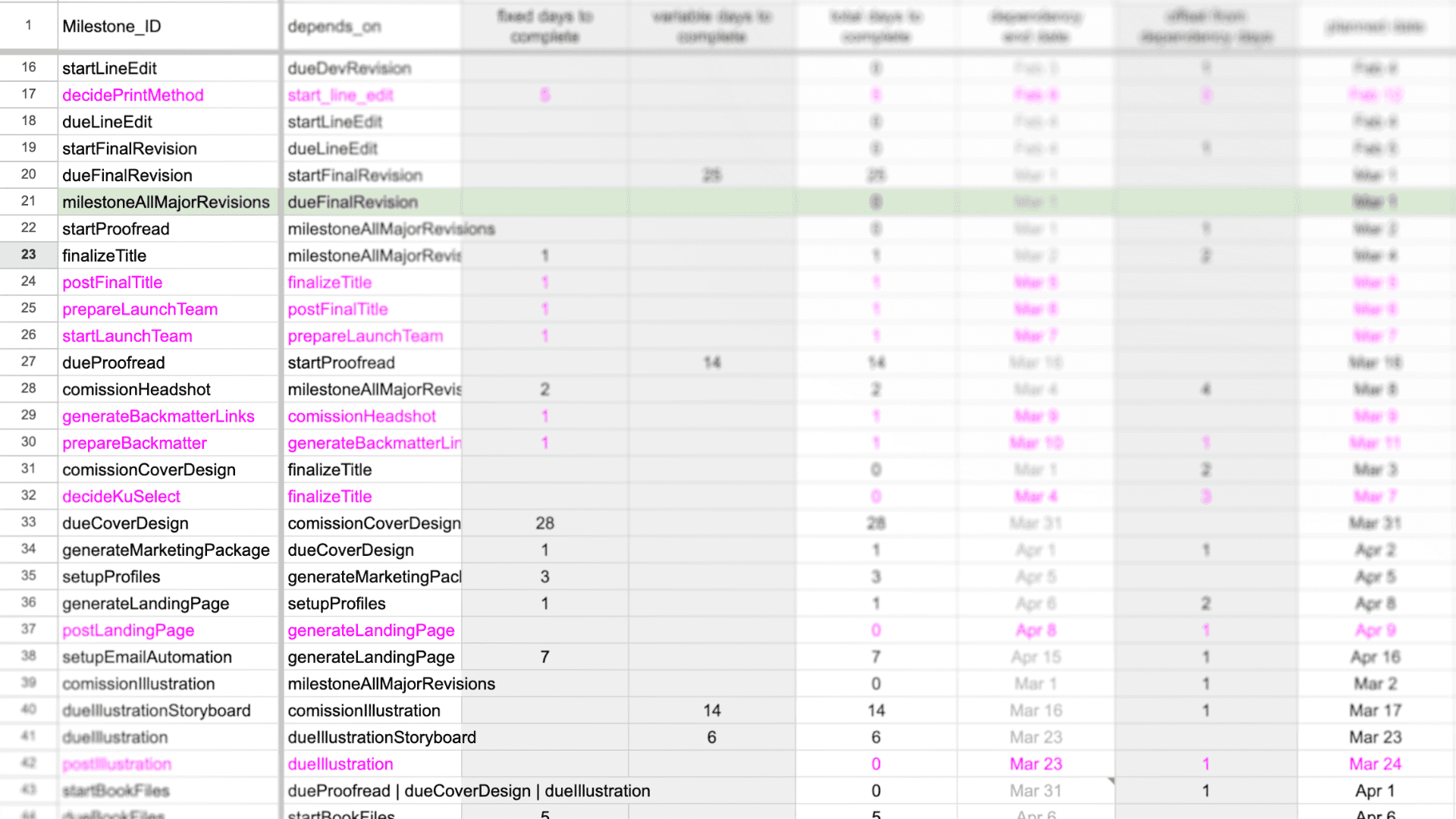
When I broke down the process, it exploded into a spreadsheet of interdependent milestones and hidden dependencies, revealing tons of unnecessary complexity.
Defining Boundaries and Scope
After mapping the system end to end, I pressure-tested it with roughly a dozen indie authors, walking through the full process together to see where it broke down.
The failure was immediate: no one made it through the entire map. The system was accurate, but its scale was overwhelming.
Success means creating a system that extracts basic information from authors about their goals, and creates a custom workflow for them that is dead simple to follow.
Topics like writing craft, post-launch ad optimization, and community features are out of scope for now.
1
Fear of missing steps that could tank the launch
Core insights
from
authors
2
Each book launch is unique, a rigid process won't work
3
Not all authors are tech savvy, and using AI is taboo
Early Concepts and Direction
The first solution, as mentioned, was a spreadsheet that accurately modeled the system but failed as an interface: too technical and brittle for most authors.
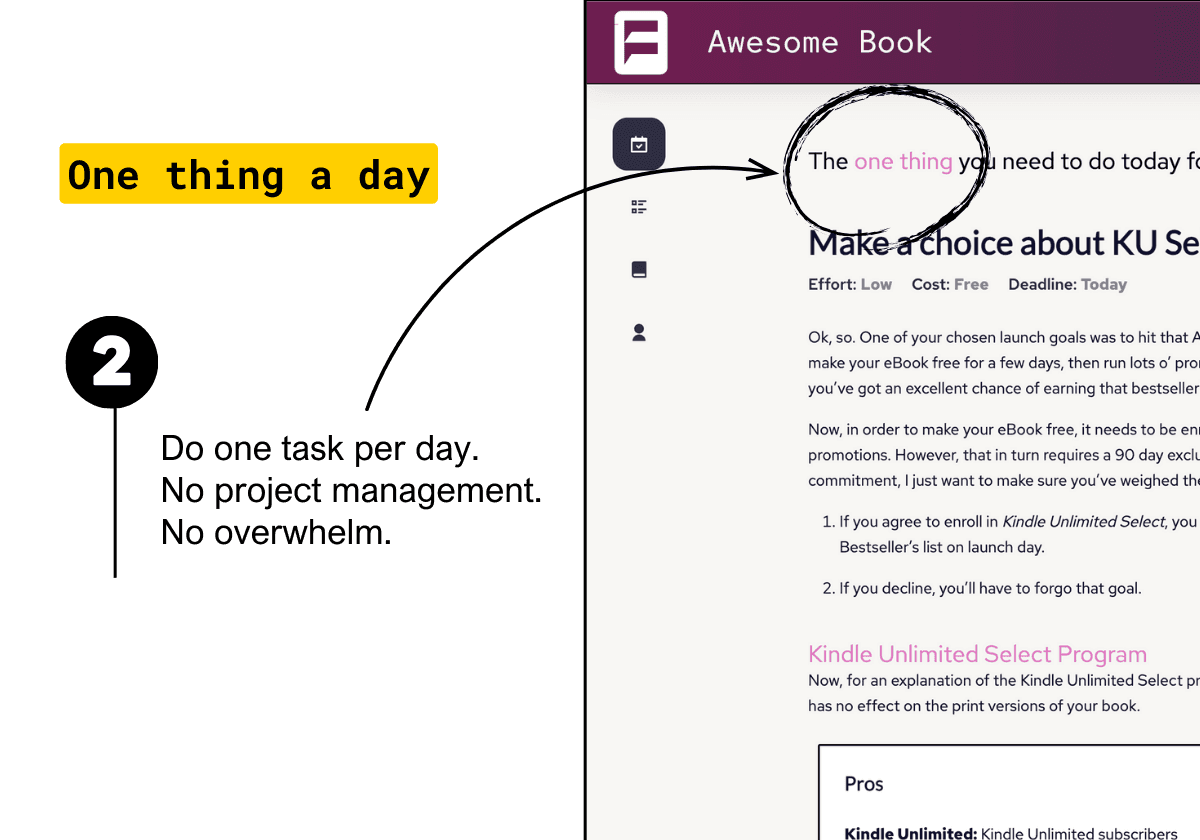
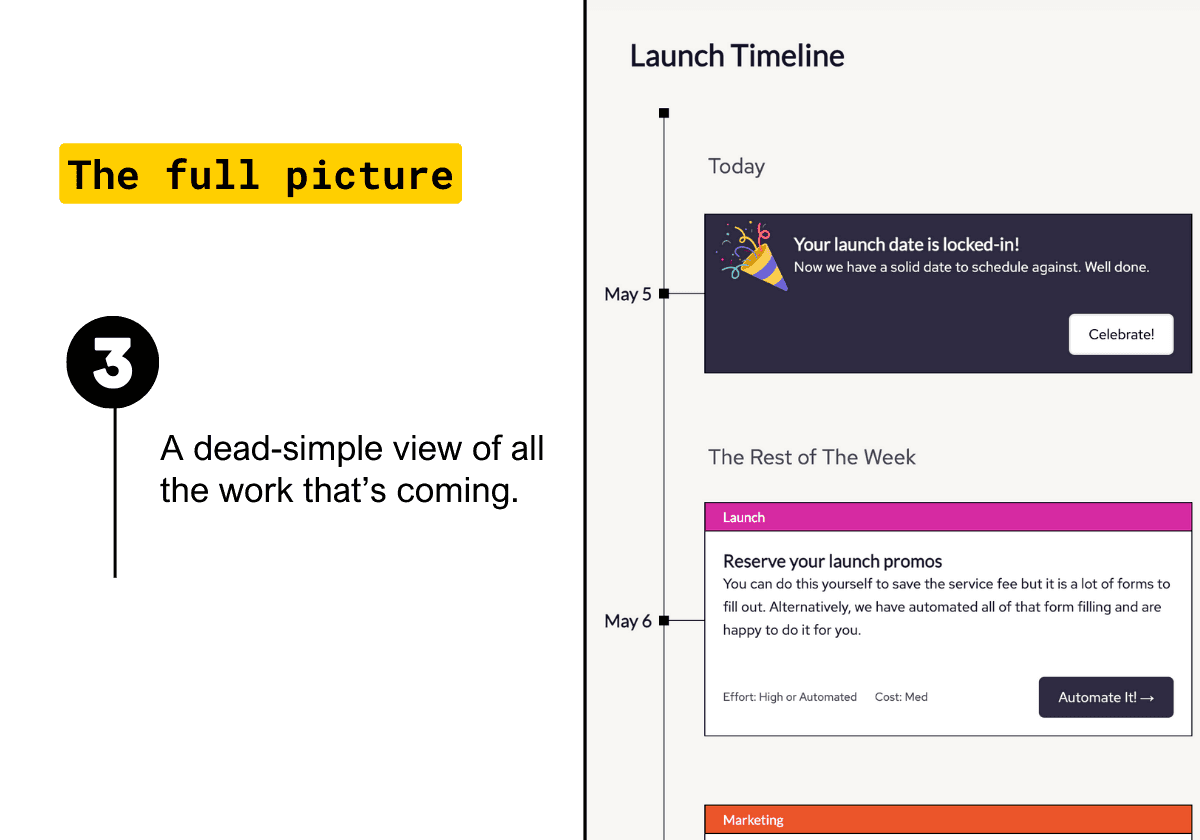
What did work immediately was a prototype of the timeline view, and a "one thing to do today" approach which made the process easier to reason about.
I also experimented with long-form, personalized PDFs explaining which steps applied to an author’s goals and why timing mattered. These were effective for building understanding, but insufficient for execution.
The product direction emerged by combining both: a system-level explanation paired with a task-by-task timeline authors could actually follow. The timeline became the organizing principle, not a feature.
Video of an early prototype used to guide user conversations
The Scaffolding For The Product
After collecting some information about the user's launch goals, the system determines which strategies they should employ, then calculates the timeline of all the nitty-gritty tasks supporting those strategies. All of that sits atop a foundation of well-appointed content.
The output they get is three-fold:
Why (strategy)
First, a long form description of the strategies. This helps them understand the process as a whole, and lets them set their cost, time and effort expectations.When (timeline)
Then, an assistant-like guide that walks them task by task through their personalized timeline.How (information)
Deeper explanation behind every task that prescribes concrete actions and, where appropriate, safe vendor recommendations.
Together, these provide a progressive disclosure which limits overwhelm, without making the process feel like a black-box (and therefore scary).
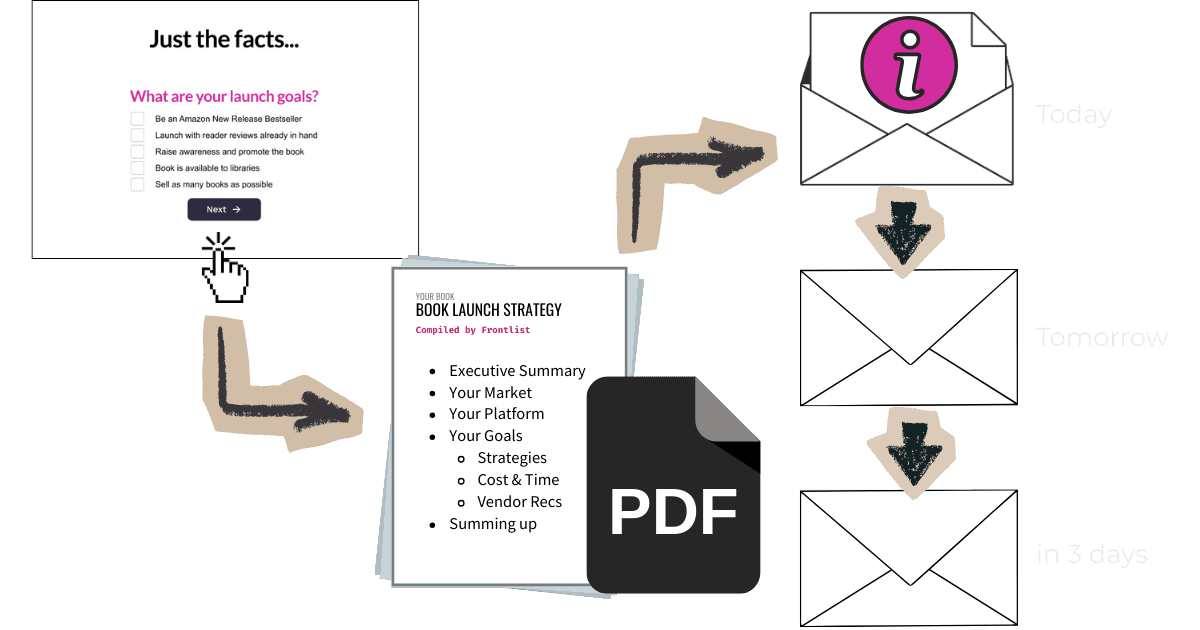
What's Shipping: Email first
I deliberately chose to build an email-only version first. This reduces development complexity and make the system easier to iterate on once real authors enter beta.
The hardest problem isn’t the interface—it’s the logic underneath it. The system must recalculate an author’s entire timeline whenever a task is completed early, late, or skipped. Prioritizing this logic ensures that any future interface is built on a timeline authors can trust.
Formal testing will begin once authors can move through a complete end-to-end timeline. The beta waitlist is open.
CONTEXT
Productivity tool for self-publishing
ROLE
UX Lead
KEYWORDS
Complexity, workflows, prototyping
STATUS
Iterations in progress
Frontlist is a personal assistant for indie authors that guides them through the entire self-publishing process. It reflects how I approach designing for complex, fragmented systems:
→ Uncovering the structure of a problem;
→ Creating a layer for user consumption;
→ Designing for iteration first, to unlock scale later.
Unique opportunity to see my process, via a work in progress
FRONTLIST:
CASE STUDY
A gnarly, Fragmented problem
To get a book from “I have an idea” to “it’s published!” an indie author has to complete 60-80 milestones spanning multiple vendors, and wade through conflicting information spread willy-nilly across the internet.
Without a clear, end-to-end workflow, indie authors routinely overspend on coaching programs, vanity or hybrid publishers, and marketing courses—often while missing critical steps like lining up reviews and promotions before launch.
NO HOLISTIC SOLUTIONS — Even newer AI solutions are task-specific. They may make parts of the process more efficient, but ultimately they're just adding pieces to the puzzle, instead of holistically reducing complexity.
Why I Couldn't Ignore the Issue
I'm an indie author! But this isn't just a me problem, 2.3 million books are self-published every year.
Because I've self-published eight titles—First Designer In, Kelly Tills kids books—newer authors would frequently ask me for advice.
I found myself repeating the same complicated, caveat-filled publishing advice on call after call. None of it could be explained cleanly. There's nothing I love more than bringing order to chaos, so I got to work.
When I broke down the process, it exploded into a spreadsheet of interdependent milestones and hidden dependencies, revealing tons of unnecessary complexity.
Defining Boundaries and Scope
After mapping the system end to end, I pressure-tested it with roughly a dozen indie authors, walking through the full process together to see where it broke down.
The failure was immediate: no one made it through the entire map. The system was accurate, but its scale was overwhelming.
Success means creating a system that extracts basic information from authors about their goals, and creates a custom workflow for them that is dead simple to follow.
Topics like writing craft, post-launch ad optimization, and community features are out of scope for now.
1
Fear of missing steps that could tank the launch
Core insights
from
authors
2
Each book launch is unique, a rigid process won't work
3
Not all authors are tech savvy, and using AI is taboo
Early Concepts and Direction
The first solution, as mentioned, was a spreadsheet that accurately modeled the system but failed as an interface: too technical and brittle for most authors.
What did work immediately was a prototype of the timeline view, and a "one thing to do today" approach which made the process easier to reason about.
I also experimented with long-form, personalized PDFs explaining which steps applied to an author’s goals and why timing mattered. These were effective for building understanding, but insufficient for execution.
The product direction emerged by combining both: a system-level explanation paired with a task-by-task timeline authors could actually follow. The timeline became the organizing principle, not a feature.
Video of an early prototype used to guide user conversations
The Scaffolding For The Product
After collecting some information about the user's launch goals, the system determines which strategies they should employ, then calculates the timeline of all the nitty-gritty tasks supporting those strategies. All of that sits atop a foundation of well-appointed content.
The output they get is three-fold:
Why (strategy)
First, a long form description of the strategies. This helps them understand the process as a whole, and lets them set their cost, time and effort expectations.When (timeline)
Then, an assistant-like guide that walks them task by task through their personalized timeline.How (information)
Deeper explanation behind every task that prescribes concrete actions and, where appropriate, safe vendor recommendations.
Together, these provide a progressive disclosure which limits overwhelm, without making the process feel like a black-box (and therefore scary).
What's Shipping: Email first
I deliberately chose to build an email-only version first. This reduces development complexity and make the system easier to iterate on once real authors enter beta.
The hardest problem isn’t the interface—it’s the logic underneath it. The system must recalculate an author’s entire timeline whenever a task is completed early, late, or skipped. Prioritizing this logic ensures that any future interface is built on a timeline authors can trust.
Formal testing will begin once authors can move through a complete end-to-end timeline. The beta waitlist is open.
CONTEXT
Productivity tool for self-publishing
ROLE
UX Lead
KEYWORDS
Complexity, workflows, prototyping
STATUS
Iterations in progress
Frontlist is a personal assistant for indie authors that guides them through the entire self-publishing process. It reflects how I approach designing for complex, fragmented systems:
→ Uncovering the structure of a problem;
→ Creating a layer for user consumption;
→ Designing for iteration first, to unlock scale later.
A gnarly, Fragmented problem
To get a book from “I have an idea” to “it’s published!” an indie author has to complete 60-80 milestones spanning multiple vendors, and wade through conflicting information spread willy-nilly across the internet.
Without a clear, end-to-end workflow, indie authors routinely overspend on coaching programs, vanity or hybrid publishers, and marketing courses—often while missing critical steps like lining up reviews and promotions before launch.
NO HOLISTIC SOLUTIONS — Even newer AI solutions are task-specific. They may make parts of the process more efficient, but ultimately they're just adding pieces to the puzzle, instead of holistically reducing complexity.
Why I Couldn't Ignore the Issue
I'm an indie author! But this isn't just a me problem, 2.3 million books are self-published every year.
Because I've self-published eight titles—First Designer In, Kelly Tills kids books—newer authors would frequently ask me for advice.
I found myself repeating the same complicated, caveat-filled publishing advice on call after call. None of it could be explained cleanly. There's nothing I love more than bringing order to chaos, so I got to work.
When I broke down the process, it exploded into a spreadsheet of interdependent milestones and hidden dependencies, revealing tons of unnecessary complexity.
Defining Boundaries and Scope
After mapping the system end to end, I pressure-tested it with roughly a dozen indie authors, walking through the full process together to see where it broke down.
The failure was immediate: no one made it through the entire map. The system was accurate, but its scale was overwhelming.
Success means creating a system that extracts basic information from authors about their goals, and creates a custom workflow for them that is dead simple to follow.
Topics like writing craft, post-launch ad optimization, and community features are out of scope for now.
1
Fear of missing steps that could tank the launch
Core insights
from
authors
2
Each book launch is unique, a rigid process won't work
3
Not all authors are tech savvy, and using AI is taboo
Early Concepts and Direction
The first solution, as mentioned, was a spreadsheet that accurately modeled the system but failed as an interface: too technical and brittle for most authors.
What did work immediately was a prototype of the timeline view, and a "one thing to do today" approach which made the process easier to reason about.
I also experimented with long-form, personalized PDFs explaining which steps applied to an author’s goals and why timing mattered. These were effective for building understanding, but insufficient for execution.
The product direction emerged by combining both: a system-level explanation paired with a task-by-task timeline authors could actually follow. The timeline became the organizing principle, not a feature.
Video of an early prototype used to guide user conversations
The Scaffolding For The Product
After collecting some information about the user's launch goals, the system determines which strategies they should employ, then calculates the timeline of all the nitty-gritty tasks supporting those strategies. All of that sits atop a foundation of well-appointed content.
The output they get is three-fold:
Why (strategy)
First, a long form description of the strategies. This helps them understand the process as a whole, and lets them set their cost, time and effort expectations.When (timeline)
Then, an assistant-like guide that walks them task by task through their personalized timeline.How (information)
Deeper explanation behind every task that prescribes concrete actions and, where appropriate, safe vendor recommendations.
Together, these provide a progressive disclosure which limits overwhelm, without making the process feel like a black-box (and therefore scary).
What's Shipping: Email first
I deliberately chose to build an email-only version first. This reduces development complexity and make the system easier to iterate on once real authors enter beta.
The hardest problem isn’t the interface—it’s the logic underneath it. The system must recalculate an author’s entire timeline whenever a task is completed early, late, or skipped. Prioritizing this logic ensures that any future interface is built on a timeline authors can trust.
Formal testing will begin once authors can move through a complete end-to-end timeline. The beta waitlist is open.
FRONTLIST: CASE STUDY
System design for end-to-end Workflow, task execution, and reduced reliance on predatory services.
System design for end-to-end Workflow, task execution, and reduced reliance on predatory services.